
Quick Answer
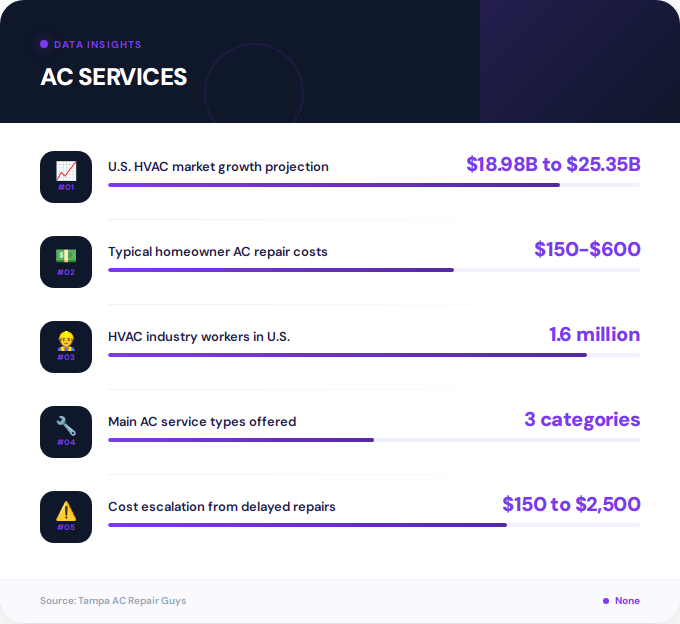
AC services cover repair, maintenance, and installation of cooling systems, and the U.S. HVAC services market is projected to grow from roughly $18.98 billion in 2026 to $25.35 billion by 2031. Costs vary widely by scope, but most homeowners see repair bills between $150 and $600, while major replacements can run into the thousands. Choosing a qualified provider for regular maintenance is the most reliable way to avoid costly emergency repairs and extend system lifespan.
Nearly 1.6 million people work in the U.S. HVAC industry today, yet homeowners still routinely delay ac services until their system fails completely, often during the hottest week of the year. That delay is expensive. What starts as a $150 fix can snowball into a $2,500 replacement if ignored long enough. Understanding what AC services actually include, what they cost, and when to call a professional can save thousands of dollars and a lot of discomfort.
This guide breaks down the real numbers behind the AC services industry, what drives pricing, and how to evaluate a provider before your system breaks down in the middle of summer.
What Are AC Services?
AC services refer to the full range of professional work performed on air conditioning systems, including installation, repair, seasonal maintenance, refrigerant handling, ductwork inspection, and diagnostic testing. These services keep cooling systems running efficiently, extend equipment lifespan, and prevent small issues from becoming expensive failures.
Most AC service categories fall into three buckets:
- Preventive maintenance: tune-ups, filter changes, coil cleaning, refrigerant level checks
- Repair services: fixing compressors, capacitors, thermostats, leaks, and electrical faults
- Installation and replacement: sizing and installing new systems, heat pumps, or ductless units
Industry organizations like the Air Conditioning Contractors of America set training and quality standards that reputable contractors follow, which is one reason certification matters when selecting a provider.
How Big Is the AC Services Market in 2026?
The AC and HVAC services industry is one of the fastest-growing segments of the home services economy. Estimates vary depending on scope, but every major data source points to sustained multi-year growth.
2031 projection: $25.35 billion
CAGR: 5.90%
5-year growth: ~4.8%
Employment: ~1.6 million
2031 projection: $98.74 billion
CAGR: 6.38%
Businesses: ~120,000
Growth 2021-2026: 2.6%
Research from Mordor Intelligence’s HVAC services market report and Fact.MR’s global HVAC services analysis both confirm mid-to-high single-digit annual growth through the early 2030s, driven largely by replacement demand and stricter refrigerant regulations. The EPA’s vintaging model on ozone-depleting substitutes outlines the regulatory backdrop pushing the industry toward newer, lower-impact refrigerants, which is one factor increasing new installation costs by roughly 10% in some markets.
How Much Do AC Services Cost?
AC service pricing depends heavily on the type of work, the age of your system, your region, and how urgently the job needs to be done. Rather than quoting a single flat number, it helps to understand typical ranges by category.
| Service Type | Typical Range |
|---|---|
| Minor repair (capacitor, thermostat, small parts) | $100 to $300 |
| Standard repair (average across most calls) | $150 to $600 |
| Major component replacement (compressor, coil) | $1,000 to $2,500+ |
| Emergency or after-hours service | 2 to 3 times standard rates |
Pricing varies based on your specific project, the complexity of the diagnosis, and equipment availability, so these figures should be treated as general guidance rather than a quote. Urban markets can run 20 to 30% higher than rural areas, and full system installation costs have climbed further as manufacturers transition to A2L refrigerants under new EPA guidelines. Given rising material and labor costs, a growing share of contractors, 83% in one 2026 home services survey, reported raising prices over the past year. For an accurate estimate, always request a custom quote based on an in-person or virtual diagnostic rather than relying on generic online averages.
Should You Repair or Replace Your AC System?
One of the clearest trends shaping the industry right now is a shift toward repair-first thinking. Homeowners are more cost-conscious, and many are choosing to extend the life of existing systems rather than replace them outright.
As a general rule, if a repair costs less than 50% of a full replacement and the unit is under 10 to 12 years old, repair usually makes more financial sense. Systems nearing the end of their expected lifespan, especially those still using older refrigerants, are better candidates for replacement given the regulatory shift already underway.
What Trends Are Shaping AC Services in 2026?
Several forces are actively reshaping how AC services are delivered and priced heading into 2026 and beyond.
- Labor shortages persist: industry projections cited by ACHR News’ 2026 HVAC predictions point to roughly 40,100 annual technician openings through 2034, keeping skilled labor scarce.
- Smart controls and predictive maintenance: AI-driven dispatch, quoting, and diagnostics are becoming standard tools for scheduling and preventing breakdowns before they happen.
- Refrigerant regulation: A2L refrigerant transitions are increasing equipment costs and requiring specialized technician training.
- Electrification and heat pumps: rising adoption of heat pumps and high-efficiency systems is being driven by both cost savings and energy codes.
- Higher indoor air quality expectations: homeowners increasingly request filtration and humidity control alongside standard cooling service.
Field service platforms like FieldEdge’s 2026 HVAC industry trends report confirm that technology adoption, particularly around scheduling and customer communication, is now a competitive differentiator, not just a back-office convenience.
How Do You Choose the Right AC Service Provider?
Not all AC service providers offer the same level of expertise, licensing, or transparency. A few questions can quickly separate reliable contractors from the rest.
- Are technicians licensed, insured, and certified to handle current refrigerants?
- Does the company provide written estimates before starting work?
- Do they offer maintenance plans, not just one-time repair visits?
- Are reviews consistent across multiple platforms, not just one source?
- Do they clearly explain repair-versus-replace tradeoffs instead of pushing one option?
A trustworthy provider will walk you through diagnostic findings, explain cost drivers honestly, and never pressure same-day replacement decisions without giving you time to evaluate options.
Key Takeaways
- The U.S. HVAC services market is projected to grow from $18.98 billion in 2026 to $25.35 billion by 2031, a 5.90% CAGR.
- Standard AC repairs typically cost $150 to $600, while major component replacements can reach $1,000 to $2,500 or more.
- Emergency and after-hours service calls can cost 2 to 3 times standard daytime rates.
- Labor shortages remain a major industry constraint, with roughly 40,100 technician openings projected annually through 2034.
- Repair-first thinking is trending, with many homeowners choosing to extend system life rather than replace prematurely.
- A2L refrigerant regulations are pushing new installation costs up by approximately 10% in some markets.
- Always request a custom, in-person quote rather than relying on generalized online pricing estimates.
People Also Ask
What is included in a standard AC service visit?
A standard AC service visit typically includes a system inspection, filter check or replacement, coil cleaning, refrigerant level check, and testing of electrical components. Technicians also check thermostat calibration and airflow to ensure the system runs efficiently.
How often should I schedule AC maintenance?
Most manufacturers and technicians recommend scheduling AC maintenance at least once a year, ideally in spring before peak cooling season. Homes in hot climates or with older systems may benefit from twice-yearly checkups.
Why is my AC not cooling even though it’s running?
This is often caused by low refrigerant levels, a dirty condenser coil, a failing compressor, or a clogged air filter restricting airflow. A professional diagnostic is the fastest way to pinpoint the exact cause and avoid unnecessary part replacements.
Is it cheaper to repair or replace an old AC unit?
If the repair cost is less than half the price of a new system and the unit is under 10 to 12 years old, repair is usually the more cost-effective choice. Older systems nearing the end of their lifespan, especially those using outdated refrigerants, often make more financial sense to replace.
How much does emergency AC repair cost compared to standard service?
Emergency or after-hours AC repairs typically cost 2 to 3 times more than standard daytime rates due to overtime labor and priority scheduling. Scheduling routine maintenance can help you avoid emergency breakdowns altogether.
Frequently Asked Questions
What are AC services?+
AC services encompass installation, repair, and maintenance work performed on air conditioning systems, including diagnostics, refrigerant checks, and component replacement. These services keep cooling systems efficient and extend their operational lifespan.
How much does the average AC repair cost?+
Most AC repairs fall between $150 and $600, though minor fixes can be as low as $100 and major component replacements can exceed $2,500. Actual pricing depends on the issue, system age, and your local market rates.
How fast is the AC services industry growing?+
The U.S. HVAC services market is projected to grow from $18.98 billion in 2026 to $25.35 billion by 2031, a compound annual growth rate of 5.90%. Growth is driven by replacement demand, stricter refrigerant regulations, and rising adoption of heat pumps.
Why are new AC installation costs rising?+
New A2L refrigerant regulations tied to EPA guidelines are increasing equipment and installation costs by roughly 10% in some markets. Manufacturers and contractors are also adjusting to updated safety and handling requirements for the newer refrigerants.
How do I know if I need a repair or a full system replacement?+
A professional diagnostic is the most reliable way to determine this, but as a general rule, if repair costs stay under 50% of replacement cost and the system is under 10 to 12 years old, repair is usually the smarter choice. Older systems with recurring issues are often better candidates for replacement.
What should I look for when hiring an AC service company?+
Look for licensed, insured technicians, transparent written estimates, consistent customer reviews, and honest repair-versus-replace guidance. Reputable providers also offer maintenance plans rather than only responding to emergency calls.